Temple highlights
What to See at Wat Phnom: Sanctuary, Lady Penh Shrine and Stupa
The important sights at Wat Phnom are concentrated on a small tree-covered hill. Slow down to distinguish religious spaces, memorial architecture and the public landscape instead of treating the temple as a single photo stop.
Open Wat Phnom on Google Maps ↗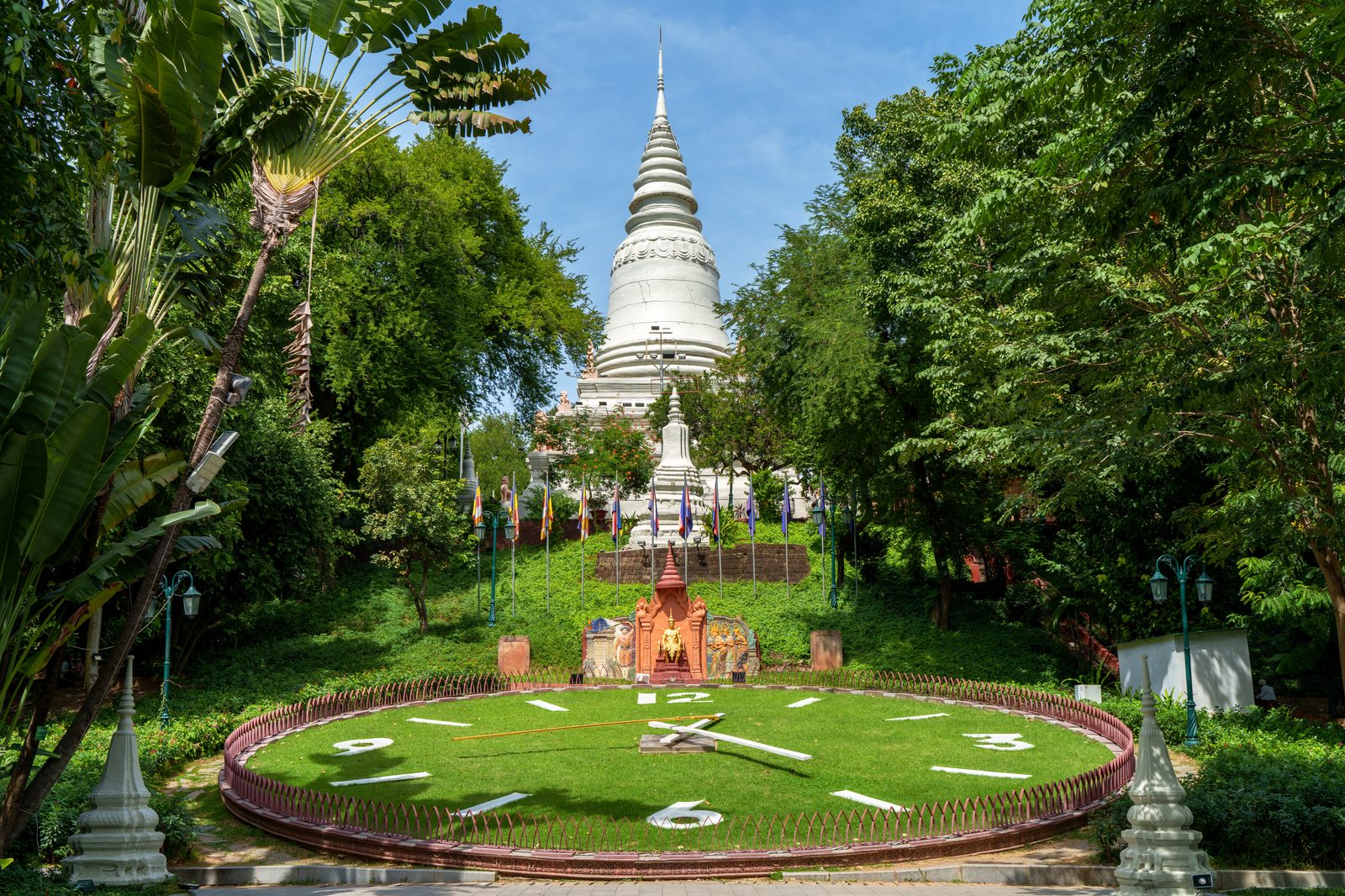
About the temple and its care
Wat Phnom is an active Buddhist temple and a public cultural landmark in Phnom Penh. Temple worship areas and the surrounding public landscape have different functions. Visitors should follow on-site guidance and respect worshippers; this independent guide does not represent its managing authorities.
Essential visitor information
- Wat Phnom Daun Penh
- Wat Phnom Road, Daun Penh, Phnom Penh 12000, Cambodia
- Plus Code
- HWGF+F6
- Suggested visit: 45–60 minutes
- Published guide hours: 07:00–19:00; verify on arrival
- Hours and admission pocket guide
- Admission may vary by visitor category; verify the current price at the entrance
The main sanctuary and roofline
The principal vihara is an active Buddhist sanctuary. From outside, study its layered roof, decorative gables and guardian imagery. Inside, follow posted rules and leave clear space for people making offerings.
The sanctuary has been restored repeatedly, including a reconstruction commonly dated to 1926. Its present appearance is therefore the result of several periods of care rather than an untouched medieval monument.
The Lady Penh shrine
Look for the smaller devotional space associated with Daun Penh, the woman in the city’s founding legend. In the story, she recovered sacred statues from a tree floating in the river and local residents built a hilltop shrine.
The shrine remains a place of personal devotion. Avoid close-up photographs of worshippers or offerings unless permission is given. Read local interpretation before retelling legendary details as historical certainty.
The royal stupa and stairways
A prominent stupa behind the sanctuary is associated with King Ponhea Yat. The setting connects the hill with the royal history of Phnom Penh as well as the Lady Penh legend.
At the approaches, look at the balustrades, guardian figures and shade trees. The stairs are part of the experience but can become slippery during rain; choose your pace carefully.
The hill and surrounding city
At roughly 27 metres high, Wat Phnom provides a rare small rise in this otherwise flat urban district. The views are more about tree canopy, temple details and everyday city life than about a panoramic skyline.
Near the base, the historic post office quarter and riverfront create a natural extension to the visit. Allow extra time if you want to photograph architectural details in softer morning or late-afternoon light.
A suggested 45–60 minute circuit
- Begin near the lower steps and observe the guardian sculpture.
- Ascend slowly to the main sanctuary; remain outside if a ceremony is underway.
- Visit the Lady Penh-associated shrine without interrupting worship.
- Walk toward the royal stupa and compare architectural details.
- Return downhill, then continue toward the old post office quarter if desired.
Photography and visitor care
- Do not use flash near worshippers or sacred objects without permission.
- Keep shoulders and knees respectfully covered; follow footwear signs.
- The hill’s pathways are uneven in places. Assess steps and access on site, especially with strollers or mobility needs.
- Use the current pocket guide for admission and opening-hour checks.
FAQ
What are the most important sights at Wat Phnom?
The active main sanctuary, Lady Penh-related shrine, royal stupa and carved approaches are the main highlights.
Can I see everything in one hour?
Many visitors can explore the compact hill in about 45–60 minutes, but ceremonies, weather and individual pace may require more time.
Continue your visit
How to Get to Wat Phnom: Riverside, City Centre and KTI Airport →
Continue your visit
Visitor reviews
For current ratings and the original visitor comments, use the dedicated Google Maps listing. Review counts change and are not independently reproduced here.
Google Maps ↗